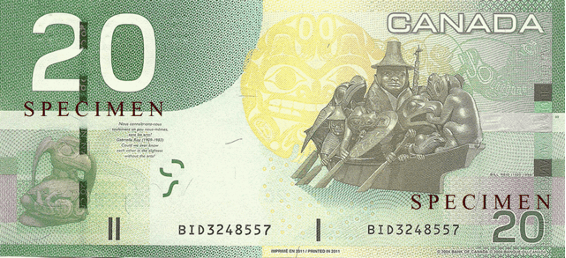
The ‘Black Canoe’ Haida artwork on the Canadian $20 bill
Dominic Lopes, philosopher of aesthetics at the University of British Columbia, spoke at the Mark Sainsbury lecture about a new kind of injustice, aesthetic injustice, which will be the subject of his forthcoming book, Aesthetic Injustice: A Cosmopolitan Theory. This notion may be reminiscent to many of us of epistemic injustice, which has recently been an extremely salient and widely discussed topic in epistemology, ethics, and political philosophy.* According to Lopes, an aesthetic injustice is a large-scale social arrangement that harms people in their capacities as aesthetic agents, which capacities serve interests in value diversity and social autonomy. Lopes applied this notion to the cases of contact between different aesthetic cultures (such as contact between indigenous Haida and mainstream Canadian culture), and spoke about cases of cultural appropriation, the weaponization of the aesthetic, and what Haida artist Yahgulanaas dubbed the “Medusa Syndrome”, whereby outsiders to an aesthetic culture can petrify the aesthetic capacities of cultural insiders, presumably via many of the same kinds of mechanisms that work in stereotype threat (which can also lead to epistemic injustices). We eagerly await Lopes’ forthcoming work on aesthetic injustice, which promises, like the notion of epistemic injustice, to be extremely fruitful and salient in discussions about cultural equality and intercultural respect, and in our everyday lives.
* Miranda Fricker originated the term “epistemic injustice”. But, importantly, Rachel McKinnon notes that minority ethnic feminist philosophers had been working on issues of epistemic injustice for quite some time before its more recent widespread uptake.
***
This is our first review of Dom Lopes’ presentation for the Mark Sainsbury Lecture, Tuesday 16th March 2021. Did you attend? Would you like to submit a review? If so, please contact vanessa.brassey@kcl.ac.uk.
by Mari Maldal (2nd Year Philosophy & War Studies).
In Albert Camus’ book, The Plague, Camus describes the unfolding of an event that has become very familiar to us during the last year; an epidemic. I want to start with highlighting this section of the book, which describes the lockdown ending:
“[O]f all those days and weeks and months of life lost to their love made them vaguely feel they were entitled to some compensation; this present hour of joy should run at half the speed of those long hours of waiting.”
Like most of us, I had many plans for 2020. My friends and I were going to travel around the UK, go to concerts, work our way through the entire menu at Spoons, and eat crappy meal deals at the Maughan while complaining about how much work we have to do, while doing absolutely nothing. I had finally discovered the free coffee machine in the Philosophy building and I was planning to make that international tuition fee worth it. This all came to a sudden halt when the world got put in a time out.
What I believe I lost the most, beside all of these exciting events, was time. Just time. Time with my friends. Time to finally being independent. Time to grow, and to create, and to be. Your student years are supposed to be some of the best years of your life, and they were finally here. It seems like a cosmic joke to get five months of it, only for it to be ripped from your hands, and end up back in your childhood room. It certainly feels like something was taken from me. Was it?
If we buy into the idea that the future exists in a similar sense as the present, it seems reasonable to me to claim that the only future that is real, is the one that is actualized. Therefore, saying “we were robbed” is a sentiment that acknowledges the feeling of being wronged, but can we really be robbed of a future that was never going to happen?
It may seem counterintuitive to suggest this. Naturally something was taken from us. If a robber steals my computer, the court would not tell me that the future in which I kept my computer was never going to happen, so I might as well accept my new computer-less existence. Of course the virus could have been avoided. Had we prepared more, had we listened to the scientists, had things unfolded differently…
But this didn’t happen. What I am questioning here is whether the future, an unfolding of a state of affairs, can really be thought of as a material possession. Was the covid-free future taken from me, if that possible future was never going to be actualized in the first place? If a person buys a computer from the store, do I get to claim it was stolen from me, because I had the intention of buying it?
I guess what I am trying to do here is to rationalize the notion that a covid-free future was never really mine in the first place. I only ever had the idea of it. Perhaps this is just an attempt to make myself feel better, to accept the current situation as solidified in reality. What has been one of the hardest things for me about this last year, besides the sickness itself, is the memory of how things used to be. Camus describes the feeling perfectly here:
“A loveless world is a dead world, and always there comes an hour when one is weary of prisons, of one’s work, and of devotion to duty, and all one craves is a loved face, the warmth and wonder of a loving heart.“
Perhaps all this talk about being robbed doesn’t matter. Perhaps, while it may be irrational to say we were robbed of a covid-free 2020, we can simply say we were robbed, period. A big part, if not most, of the human experience is not rational at all. This last year has been incredibly hard, we have all gone through something very painful, and we have experienced our hopes and plans for the future taken away. This is a wrong indeed.
And yet, someday, not too far from now, we will meet again. We will step out of our bubbles and into the world, feel the sun on our faces, and smile. It will be alright. For while that hope of the future may have been taken from us, the crime committed is perhaps more closely described as an involuntary loan, rather than a permanent theft.
We are approaching the finish line, and we can see, in the distance, if we look hard enough, a little, bright thing with feathers.
****
Please get in touch with vanessa.brassey@kcl.ac.uk if you would like to reply to this post or post something on a topic you have been thinking about.
Before coming to King’s, I was a postdoctoral fellow in PPE program at Virginia Tech. The campus is located in beautiful Blacksburg, which sits right next to the Appalachian Mountains of Virginia. Before this, I completed my PhD just next door to King’s at the London School of Economics.
What will you be teaching this term?
In Semester 1 I taught History of Political Philosophy. The module considered authors chronologically but was split in two themes. The first half examined the social contract theories of Thomas Hobbes, John Locke and Jean-Jacques-Rousseau. Core themes that we considered included natural law, political obligation and legitimacy. The second half focused on accounts of freedom and unfreedom, including Mary Wollstonecraft, J. S. Mill, Frederick Douglass and Karl Marx. Core themes included the possibility for freedom in society along with how to how to diagnose and oppose forms of unfreedom.
In Semester 2 I am teaching Morality and Convention, a module that examines the role that social convention plays in morality. The module addresses the following general questions. First, what is a social convention and what is it for a convention to be in force in a given population, how are such conventions learnt or transmitted and how do they change? Second how ought we to react to the existence of a certain convention in our community? Third, how much of the social fabric of a developed society is conventional. There are norms defining family structures, games, and personal relationships (friendship, neighbourliness), systems of property rights and private law, rules of etiquette and communication etc. Are these rules, systems and norms purely conventional, partly conventional or not conventional at all?
How did you get into philosophy?
The initial spark came from music, as I recall! I remember listening to bands like The Clash midway through high school and being fascinated by the political themes in their lyrics. This led me to read around and eventually take up philosophy at A Level, where we studied Sartre’s Existential is a Humanism, along with modules such as political philosophy and epistemology. After this, I was hooked!
Your doctorate focused on the ethics of risk and uncertainty.Can you give us the 2 minute elevator pitch summarizing your contribution?
My doctorate examined a set of questions in the area of the ethics of risk and uncertainty. One of the core questions was how should the presence of risk and uncertainty affect how we distribute a benefit to which individuals have competing claims? In response, I developed and defended an egalitarian theory of distributive ethics that is sensitive to the presence of risk and severe uncertainty (where it is not possible to assign probabilities to potential outcomes). I argued that some types of risk can themselves ground complaints from those who are subject to them, whereas others cannot. I also argued that severe uncertainty (where we cannot assign a precise probability to a potential outcome) can itself constitute a burden that ought to be distributed equally where possible.
A further question of the doctorate was how one should approach doing good (such as saving some people from harm) when there is a risk that in doing so one will enable an evildoer to commit harm. I had in mind real-world cases such as the provision of United Nations humanitarian aid to civilians in Syria in 2016, where there were fears the aid would further enable the Syrian government and lead to a manipulation of the aid for nefarious purposes. I defended a “clean hands” view and argued that in the type of “villain-enabling” cases that I described, those who provide aid can do so permissibly.
How do you balance the intellectual with the practicalities of daily life?
I think I struggle to separate them! I find it easier to separate the intellectual from the mundane practicalities of daily life, but I find it difficult to separate the intellectual from my hobbies. A couple of these are Chess and the official Fantasy Premier League game (where I try to put my interest in decision-making under conditions of risk and uncertainty to use).
You write on lotteries and fairness. Recently, you suggested fairness requires weighting lottery cases to reflect weighted claims to the good. What might be counted as a weighted claim to the good for you?
A lottery is weighted when one potential recipient receives a greater chance than another. A claim is a reason why someone ought to receive a good. For example, a person will have a claim on a medicine if they need it in order to cure a disease. The weight of a claim is determined by its comparative strength. For example, if, when everything else is equal, I need the medicine twice as much than you do, then my claim can be said to be twice as weighty as yours. A weighted lottery is a way of allocating goods in proportion to this comparative strength (e.g. if I need the medicine twice as much, then I get twice as much chance than you in a lottery).
Weighted lotteries have been used for such things as school admissions in the U.S., and for the allocation of scarce COVID-19 treatments (where those who need the treatment more get a higher chance than those who need it less, but everyone still gets a chance of receiving the treatment). In a recent paper, I argue that fairness requires the use of a weighted lottery when some individuals have stronger claims to an indivisible good than others. I argue against rival positions which say either that we ought to just give the good directly to the person with the stronger claim, or that we ought to use a weighted lottery only sometimes, such as when the strength of claims to a good are only slightly unequally strong.
What is the puzzle that keeps you awake at night?
One puzzle that has been occupying me recently is how it is that a risk of harm could itself be harmful, even when the “victim” is completely unaware of the risk, and the risky action doesn’t result in the harm that it threatens. A few authors have recently argued that such risks can be harmful. I have some work in progress which tries to address this problem, where I argue that risks themselves aren’t harmful because they do not interfere with the “victim’s” interests in the right way. But this still feels a little unsatisfactory to me!
In a new article for Aeon magazine, Sarah Fine contemplates the different dimensions of art as meaning maker in times of crisis. The article discusses art’s role in fomenting the hope of survival, expressing challenging emotions, empowering articulation of thought or conveying personal protest. Read the full article just published in Aeon magazine here
Before coming to King’s I worked at various universities across Europe. I was in the Philosophy Section at the University of Copenhagen for six years. I then joined the Jean Nicod Institute at the Department of Cognitive Studies at École Normale Supérieure, Paris, for a year. Most recently, before coming to King’s, I was a member of the LOGOS group at the University of Barcelona.
What will you be teaching this term?
This term I am teaching Neuroscience and the Mind, which is an introduction to philosophy of mind tailored specifically to students following the BSc in Neuroscience or other undergraduate courses in the Health Schools.
How did you get into philosophy?
At secondary school! My school generally encouraged reflection: lessons in “Scripture” were built into our curriculum and would involve the teacher leading a kind of seminar discussing concepts like justice, love, time, etc. as they are raised in various ancient texts, such as the Bible and the Bhagavad Gita. I had a fantastic English teacher, Katharine Watson, who took it upon herself to teach philosophy at AS and A-level. It was her first time teaching the material, which must have been a challenge, but I only realised this later on, as she did such a fantastic job introducing us to the distinctive framing and treatment of philosophical problems in academic philosophy.
In a recent article you argue that we can combine multiple first person perspectives under one unified perspective. What do you think is minimally required for a perspective to pertain?
Well, most of my work on the notion of perspective is in the context of thinking about perceptual experience. In that context, whenever there’s a perspectivally structured experience, there’s a perspective – for a perspectival structure is, I take it, an organisation of content determined by a perspective. That’s a slightly uninteresting answer though. Perhaps more interesting is to think about perspective more broadly. After all, being perspectivally structured is a property not only possessed by perceptual experiences. Here I am interested in the kinds of perspective structuring images and various other ways of representing time and space. Indeed, in a broader sense of the notion of a perspective, it characterises any representation which is structured in relation to some privileged something, such as a theory, a group-identity, or a set of political or social ideas.
How central is the notion of a perspective to your research?
Well my interest in perspective is really a part of my interest in problems to do with self-consciousness. Take, for instance, the problem elusiveness: self-consciousness is supposed to involve a special relation to oneself as a subject of thought and experience; but how is it that we are able to think about or experience that which is thinking the thought or having the experience? I am interested in the viability of an embodied approach here, according which each subject of experience is a special kind of object, a conscious, thinking body. If we assume this and we grant the obvious fact that we do experience our bodies, it would seem, then, that we have an obvious response to the problem. So my interest in perspective is really an interest in what is right (or wrong) with an account along these lines, one which appeals to the perspectival structure of perceptual experience as a means by which we can be aware of ourselves as embodied.
Your research goes beyond conceptual investigations and include a wide of pool of collaborations. Can you tell us about teh work you have done with the artist Mariam Zakarian?
Mariam was involved in a workshop that I organised at the University of Copenhagen on virtual reality (VR) technology. VR presents the promise of otherwise impossible forms of experience, unconstrained by the bounds of physical reality, stretching our current understanding of the limits of experience. I wanted to ground the theoretical discussion properly in the subject matter, so I worked with Kasper Hornbæk and Aske Mottelson at the Computer Science department to set up a demonstration area where participants could experience various virtual worlds for themselves. (Mariam’s demonstration was part of her Amaryllis series: http://www.amaryllisvr.com/ ). I think that the experience of VR, especially the experience of its contents as plausible, are a great example of how some of our experiences are partly self-constructed, in virtue of our mental activity transforming incoming sensory experience to form a state of imaginative perception. I think that this will allow us to reconsider a wide range of illusions as really cases of imagining sensorially present objects to be things that they are not.
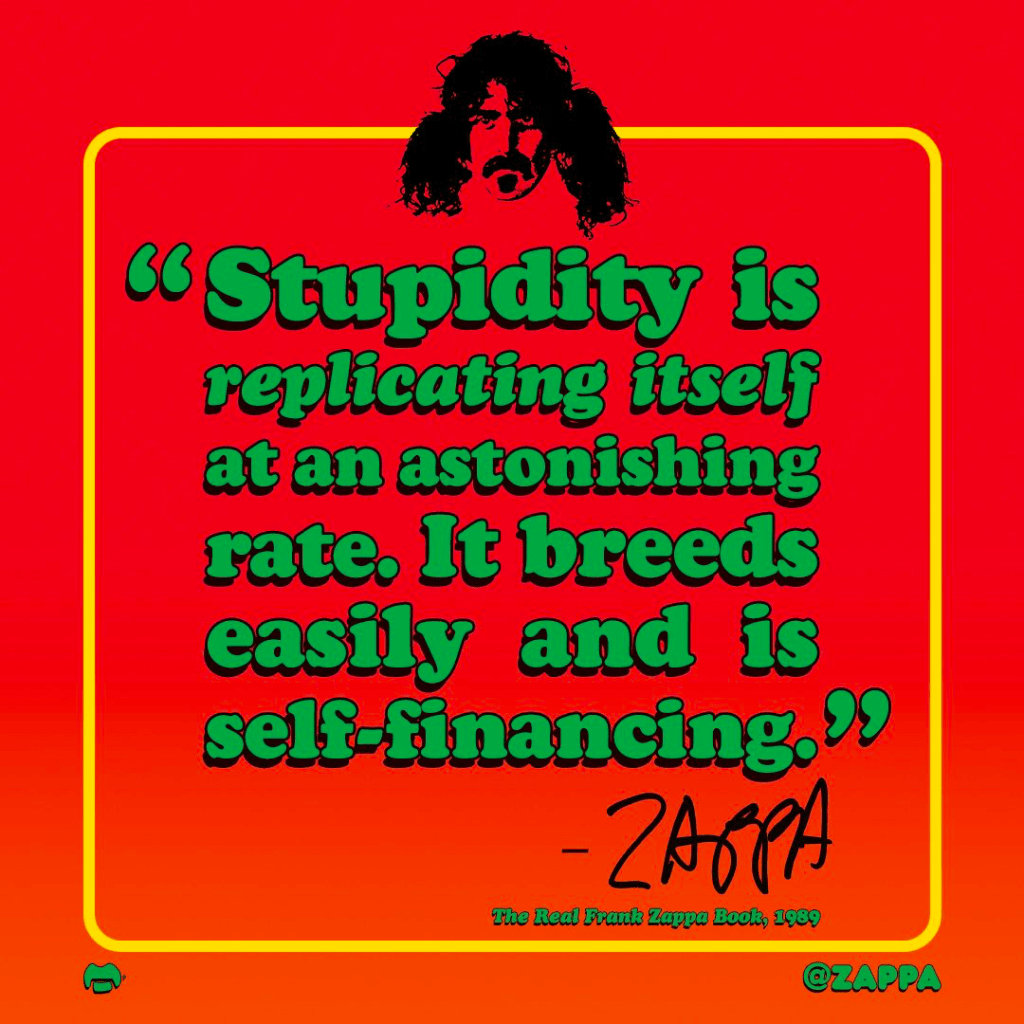
Sacha Golob, writing in The New Statesman, says that “Stupidity is failure’s mental scaffolding: those in its grip worsen problems even as they try to think them through.”
He asks, how might your common or garden fool be differentiated from your naive dupes? Are useful idiots also dumb? Or, might they they be guilty of a sort of intellectual-idiocy? What does IQ have to do with ability? And why, when pointing an accusing finger as your opponent and charging them with stupidity-in-the-first-degree, should we pay attention to the way we simultaneously point three fingers back at ourselves?
I’ve been at King’s for a while now, but in different guises. I did an MA and my PhD in the Department of Philosophy and have more recently been a Visiting Research Fellow. As a VRF, I’ve been running a programme of philosophy courses in London prisons, for which King’s has provided the lion’s share of funding. This year I’ve also been working as an Associate Tutor at Birkbeck. Before all this, I studied an MPhil in history and philosophy of science and a BA in chemical engineering at the University of Cambridge. I also worked as a teaching assistant in engineering and materials science at Queen Mary University of London.
What will you be teaching this year?
I’m officially in two Departments at King’s (Philosophy and Classics), so I’m running courses in both. In Philosophy, I’m teaching Greek Philosophy I – a first-year module that introduces students to ancient Greek philosophy. We’ll be studying a fairly broad range of thinkers: some Presocratics, Socrates, Plato, Aristotle, and a number of neo-Pythagorean women philosophers. I’m also co-convening Political and Economic Philosophy, a first-year course primarily for Philosophy, Politics, and Economics students. For this, I’m teaching 5 weeks of contemporary political philosophy. We’ll be getting to grips with several key political ideals, such as justice, liberty, equality, and democracy. In Classics, I’m teaching Introduction to Ancient Philosophy (another introduction to ancient Greek and Roman philosophy), as well as a third-year module on ancient Greek political philosophy. Most of this is devoted to Plato’s Republic and its reception, but we’ll also be considering earlier political thought in the epic poets (Homer and Hesiod), the historians (Herodotus and Thucydides), and Athenian politicians such as Solon and Pericles.
How did you get into philosophy?
Slowly. I was introduced to philosophy at high school by a religious studies teacher who tended to emphasise the philosophical puzzles at the heart of the subject. Lots of our classes consisted of discussion, which really brought things to life for me. But it wasn’t until after studying chemical engineering that I started reading philosophy again, as an MPhil student in history and philosophy of science. Here I did a little philosophy of science and mind, but was really fascinated by ancient Greek science and mathematics. Somewhat circuitously, and encouraged by my supervisor at the time, I started reading more ancient Greek philosophy, particularly Aristotle. I really enjoyed the mixture of philosophy, textual interpretation, and history that’s involved in ancient Greek philosophy. I eventually came to the Department of Philosophy at King’s to properly convert to philosophy and was lucky enough to do my PhD here as well. Both my identity as a philosopher and my sense of what it means to do philosophy was really formed at King’s, where I met and was supported by a great community of graduates and staff.
Your doctorate focused on Aristotle’s epistemology. Can you give us the 2 minute elevator pitch summarizing your contribution.
My doctoral research focused on motivating and explaining two ideas. The first is that Aristotle’s epistemology is value-driven, in so far as Aristotle is principally interested in accounting for epistemic states that are ideal. So, for example, when he gives an account of knowledge (epistêmê) in the Posterior Analytics, he is giving an account of an ideal form of knowledge. As such, whether or not Aristotle provides a satisfactory account will depend primarily on whether he describes an epistemic state that is in fact valuable. The second idea is that Aristotle explains such value with recourse to virtue: ideal epistemic states are valuable in part because they are intellectual virtues (an idea prominent in the Nicomachean Ethics). But then we’re left with the further question: why are intellectual virtues valuable? What makes them worth pursuing?
Focusing in particular on the virtue of theoretical wisdom (sophia), I argue that intellectual virtue is valuable because of its transformative nature: in order to have the virtue of theoretical wisdom, it is necessary to understand the goodness of the proper objects of theoretical wisdom (theoretical truths) such that one develops a love for the proper activity of theoretical wisdom (contemplation). This love is in turn required for contemplation to be a constitutive part of the wise person’s flourishing (eudaimonia). Theoretical wisdom thus transforms contemplation and its proper objects into something good for the wise person.
This, it seems to me, is a strange view: Aristotle not only thinks that some theoretical truths are good, but also that they are good for us to know! Nonetheless, I do think it is Aristotle’s view. I also argue that some recent neo-Aristotelian virtue epistemologies end up in a mess when they try to explain epistemic value, because they abandon these peculiar aspects of Aristotle’s account. Indeed, it’s precisely the goodness of certain truths that ultimately grounds the value of theoretical intellectual virtue on Aristotle’s view. So, one of my main take home messages is that, if you want to be an Aristotelian virtue epistemologist, you might have to buy into some of his more peculiar ideas!
How do you balance the intellectual with the practicalities of daily life?
I’m not sure whether I do! My habit is to write to-do list upon to-do list, and set loud reminders on my phone to make sure I don’t forget anything essential. To be honest, though, none of this works particularly well. I tend to do all of the practical things I have to do in a frantic rush, just before I really have no more time to do them!
You won an award for your contribution to the ‘philosophy in prisons’ project. How did you get into that and are you still involved in delivering programmes?
I started work on the prisons project back in 2015. I was on a period of interruption from my PhD, in part because I was feeling pessimistic about the worth of academic philosophy. MM McCabe suggested that I try teaching philosophy in prison (I think she had recently met people working on the excellent Princeton Teaching Initiative). If I remember right, the rough idea was to try to rediscover the worth of philosophy by doing it in what was (for me) a new and radically different context. I was immediately really excited about this and, with MM and Bill Brewer’s support, started contacting prisons. We ended up having a particularly warm reception from staff at HMP Belmarsh, so I extended my interruption to a full year and set about preparing a 10-week pilot course. Since then, the project has really blossomed.
With my two main collaborators – Andy West and Andrea Fassolas – we’ve delivered a host of courses at several London prisons. The last courses were back in 2019, at Belmarsh and Wandsworth. We also delivered one at Downview, our first at a women’s prison, which was funded by Philosophy in Prison – a charity established by King’s philosophers MM McCabe and Bill Brewer, along with their colleague, Tom Harrison. I had been planning three new courses with the charity for summer 2020, all of which had to be indefinitely postponed in the wake of the pandemic. Face-to-face education in prisons halted in March 2020, with prisoners spending the vast majority of time in their cells. Unfortunately, prison regimes are still severely limited and it’s not possible for external educational providers to come into prisons at the moment. In response, I’ve been working with Philosophy in Prison and a number of philosophers on a series of videos in lieu of in person teaching, all of which can be freely accessed and broadcast by prisons. I’m also co-editing a special issue of the Journal of Prison Education and Reentry on philosophy education in the prison context, with Kirstine Szifris (MMU).
Working in prison is extremely rewarding and enriching. In addition to getting to know lots of really interesting people and have engaging philosophical conversations, my experiences have also been philosophically enriching, making me think harder, for example, about the nature and value of epistemic virtues such as open-mindedness. Our students also report a whole variety of benefits, from being empowered with the confidence to re-engage in formal learning and education, to a richer understanding of both themselves and other people, to a sense of community amongst peers that they otherwise lacked in prison. On the other hand, this project has also given me some understanding of the very real, problematic, and damaging aspects of our prisons. In spite of the hard work of many prison managers and staff, our prisons often have people living in incredibly poor conditions, where prisoners are frequently unsafe and have little opportunity to craft and live meaningful lives. This is so much the case that the mere task of teaching in prison, let alone being imprisoned there, can often be upsetting and unsettling.
What is the puzzle that keeps you awake at night?
I’m stuck on a particular puzzle about the value of knowledge. Aristotle draws an apparently strict divide between theoretical and practical knowledge. What’s more, he sometimes claims that theoretical knowledge is useless. One way of thinking about this is that theoretical knowledge has no practical value. This raises an obvious question: what’s the value of theoretical knowledge, if it’s practically useless? Note that we need not buy into Aristotle’s particular characterisation of theoretical knowledge for this puzzle to get off the ground. All we need is the idea that there is some type of knowledge that has value independent of its practical usefulness, e.g. knowledge of astrophysics, which clearly has practical pay-offs but plausibly has value independent of such utility. So, what is that value, exactly? Is it a peculiarly epistemic value, e.g. in so far as grasping truth is of epistemic value? This seems likely right to me, but I don’t think it goes far enough. I don’t think it’s sufficient to explain, for example, the fact that people build whole lives around theoretical pursuits. Alternatively, might we think that theoretical knowledge has some kind of non-practical, prudential value? For example, is attaining this kind of knowledge somehow related to human flourishing? Perhaps, but it’s really unclear how we should spell this out – that’s what I’m puzzling over at the moment!
If not philosophy, then what?
That’s a difficult question. If I’m not doing philosophy, I tend to gravitate as far from cerebral activities as possible. I really enjoy how sport absorbs my focus – running, climbing, cycling, and hiking are favourites. I also took up skateboarding during lockdown, though I’m not sure that will last; I don’t think I’ve got the nerve for it, plus I bruise way easier than I used to! I also enjoy the usual things: music, cooking, video games and the like. If I stopped being a career-philosopher, then I don’t know what I’d do. I have the occasional fantasy of brewing beer – perhaps I could recollect my past life as a chemical engineer!
Prof Maria Rosa Antognazza will be presenting a paper this evening at the Aristotelian Society on The Distinction of Kind between Knowledge and Belief. The presentation, which will be hosted on Zoom, will be available later as a podcast. Both a draft of the paper and a link to the podcast are available here.
The Distinction of Kind between Knowledge and Belief.
Abstract:
Drawing inspiration from a well-attested historical tradition, I propose an account of cognition according to which knowledge is not only conceptually and ontologically prior to belief; it is also, and crucially, not a kind of belief. In turn, believing is not some sort of botched knowing but a mental state fundamentally different from knowing, with its own distinctive and complementary role in our cognitive life. I conclude that the main battle-line in the history of epistemology is drawn between the affirmation of a natural mental state in which there is a contact between ‘mind’ and ‘reality’ (whatever the ontological nature of this ‘reality’), and the rejection of such a natural mental state. For the former position, there is a mental state which is different in kind from belief, and which is constituted by the presence of the object of cognition to the cognitive subject, with no gap between them. For the latter position, all our cognition is belief, and the question becomes how and when belief is permissible.
Epidemiological models have been frequently mentioned in the media lately. What are they? And how do they work? Professor Alexander Bird with the Sowerby/King’s Philosophy & Medicine project has helpfully produced this introduction to epidemiological modelling for the layperson.
The particular model he will be looking at is the SIR model developed by Kermack and McKendrick in 1927.
Here’s a link to the project. Professor Bird has also produced a paper to accompany the video which is available here.
As everyone is locked up, Clayton Littlejohn has been helpfully recording and gather talks on some recent work in philosophy. This talk is an informal presentation of a paper written with Julien Dutant on epistemic rationality and defeat. It presents a new unified theory of defeat according to which the toxicity of rationality defeaters has to do with the way in which they serve as indicators that we cannot know certain things. The paper engages with recent work on epistemic paradoxes, epistemic rationality, and recent work on defeat.
If you are interested, there are more videos available here.


 King's Philosophy