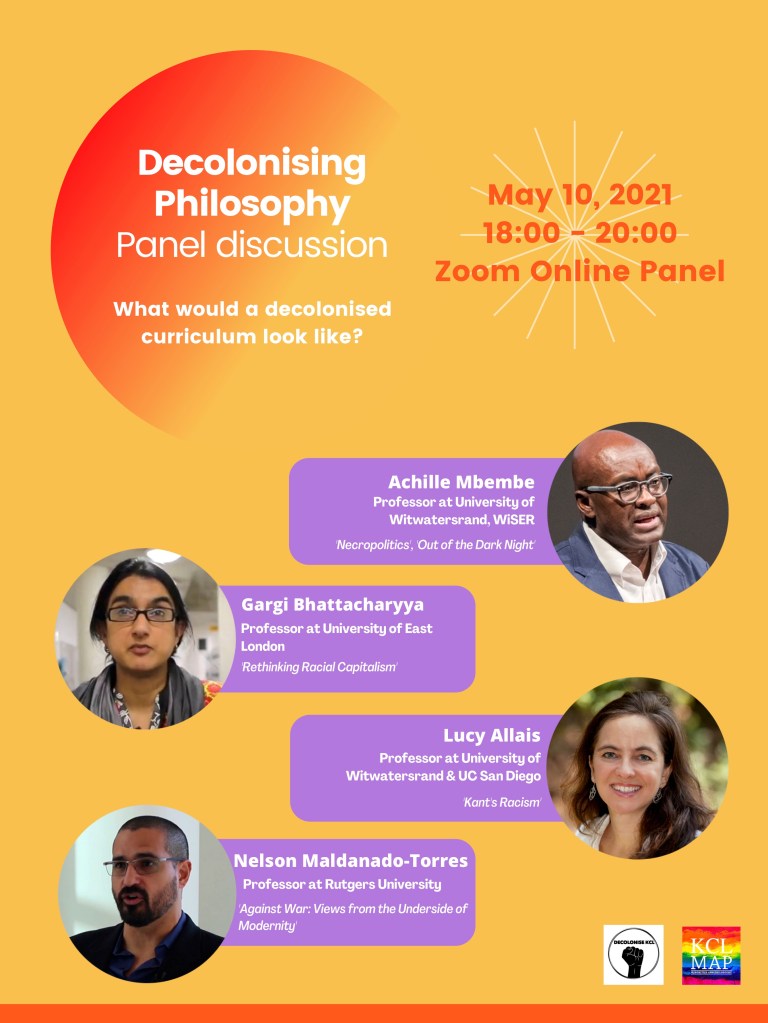
What would a decolonised curriculum look like? Join us 6-8pm on May 10th over Zoom. We have a very exciting panel of guest speakers who will discuss the decolonisation of philosophy, followed by a Q&A.
Speakers:
Achille Mbembe (Professor at University of Witwatersrand WiSER) ‘Necropolitics’, ‘Out of the Dark Night’
Gargi Bhattacharyya (Professor at University of East London) ‘Rethinking Racial Capitalism’
Lucy Allais (Professor at University of Witwatersrand & UC San Diego) ‘Kant’s Racism’
Nelson Maldanado-Torres (Professor at Rutgers University) ‘Against War: Views from the Underside of Modernity’
This event has been organised by Naomi Snow in collaboration with Decolonise KCL and KCL Minorities and Philosophy Society.
The Centre for Philosophy and Visual Arts at King’s College London (CPVA) is promoting a new project titled “A First Brush with Philosophy“.
We are seeking candidates to feature in a series of videos where they will have a conversation with a philosopher on a topic of their choice. The candidates don’t need to have any previous experience in philosophy.
The concept is fairly simple: an opportunity for you to discuss a “real-life” problem and test which benefits a philosophical discussion can bring. You will be matched with an expert who is going to be your guide in the quest for conceptual clarity.
The session progresses in three easy stages (1) pick a topic and receive a one page-primer that’ll get you thinking and probably a bit puzzled; (2) Tune into your Zoom appointment at the agreed time with your hand-selected guide and they’ll guide you through the puzzle; (3) After a 15-minute meeting we’ll ask you how it all went and whether you would recommend the experience.
During the discussion, an artist will be sketching so that they can produce a portrait of the ‘a-ha’ moment. The portrait and the video will feature on our website.
Professor Alvarez is Head of the Philosophy Department at King’s College London. She works on agency, choice and moral responsibility. This weekend her opinion piece in regard to Covid passports was published in The Guardian newspaper. Read it in full here.
“More than 160 years ago John Stuart Mill argued that in a “civilised community”, the only justification for government coercion is the prevention of harm to others. In the UK, and many other countries, long before Covid, coercive state measures, from taxes to car seatbelts, were pervasive and accepted on grounds that go beyond Mill’s justification, or at least involve a very broad interpretation of his harm principle…Some have questioned whether the restrictions have been proportionate.”
What do you think? Read the article to find out whether you agree with Professor Alvarez.
Mark Sainsbury (right) attending Dom Lopes’ (left) Mark Sainsbury Annual Lecture
In case you missed the fantastic reviews of the recent Dom Lopes’ Mark Sainsbury lecture, here is a round up of what was said, by whom, with links to the original post.
Join us for the AnnualPeace Lecture – online link to follow.
Tuesday 11 May 2021, 17:00-19:00
Cécile Fabre:
Snatching Something From Death:
Value, Justice, and Humankind’s Common Heritage
When Notre-Dame Cathedral was engulfed by fire on April 15, 2019, the world (it seemed) watched in horror. On Twitter, Facebook, in newspapers and on TV cables ranging as far afield from Paris as South Africa, China and Chile, people expressed their sorrow at the partial destruction of the church, and retrospective anguish at the thought of what might very well have happened – the complete loss of a jewel of Gothic architecture whose value somehow transcends time and space. My aim in this lecture is to offer a philosophical account and defence of the view that there is such a thing as humankind’s common heritage, and that this heritage makes stringent moral demands on us. I first offer an account of the universal value of (some) heritage goods, and then offer a conception of justice at the bar of which we owe it to one another, but also to our ancestors and successors, to preserve that heritage.
Professor Cécile Fabre is a Fellow of the British Academy, Senior Research Fellow at All Souls College, and Professor of Political Philosophy at Oxford University.
The lecture will be chaired by Professor MM McCabe, FBA, Chair of the British Academy Philosophy Section and Professor of Ancient Philosophy Emerita, King’s College London.
The Peace Lectures are due to Alan Lacey, a life-long pacifist who taught philosophy at King’s College London for some fifteen years, and who left a generous bequest to fund a lecture series promoting peace.
Hearing these words when you’re trying to report an injustice you’ve experienced is to experience an additional, often overlooked and underestimated kind of injustice – testimonial injustice, which Fricker defines as a kind of injustice that occurs when prejudice causes a hearer to give a deflated level of credibility to a speaker’s word. In recent times, we’ve heard about these sorts of responses and this kind of injustice being perpetrated against women who report sexual harassment and sexual assault, as well as against members of minority ethnic groups (think about responses to Meghan Markle’s recent interview on racism and attitudes toward mental health issues).
The performance of Asylum Monologues by Ice&Fire, in which actors performed three asylum seekers’ first-hand accounts of their experiences of the UK asylum system highlighted the prevalence and the negative consequences of testimonial injustices perpetrated against asylum seekers. For example, in the first-hand account of Denise, a woman from Nigeria who sought asylum in the U.K. on the basis of her LGBTQIA+ identity, her claim for asylum was met with similar incredulous responses by various officials who accused her of lying about her sexual orientation. In addition to the hardships that led her to seek asylum then, Denise suffered the further injustices of being disbelieved and of being accused of being disingenuous. One consequence of these further injustices, which compounded other experienced injustices, was the deterioration of Denise’s mental state to the point of an attempted suicide.
Perhaps, just as the #BelieveWomen movement went viral in the wake of the Prof. Christine Blasey Ford’s testimony about being sexually assaulted by now U.S. Supreme Court Justice Brett Kavanaugh, we need support for a similar movement for asylum seekers whose experience of testimonial injustices compounds the injustices and hardships they already face – #BelieveAsylumSeekers ? – and really for members of all marginalized groups who are often forced to suffer being silenced in silence.
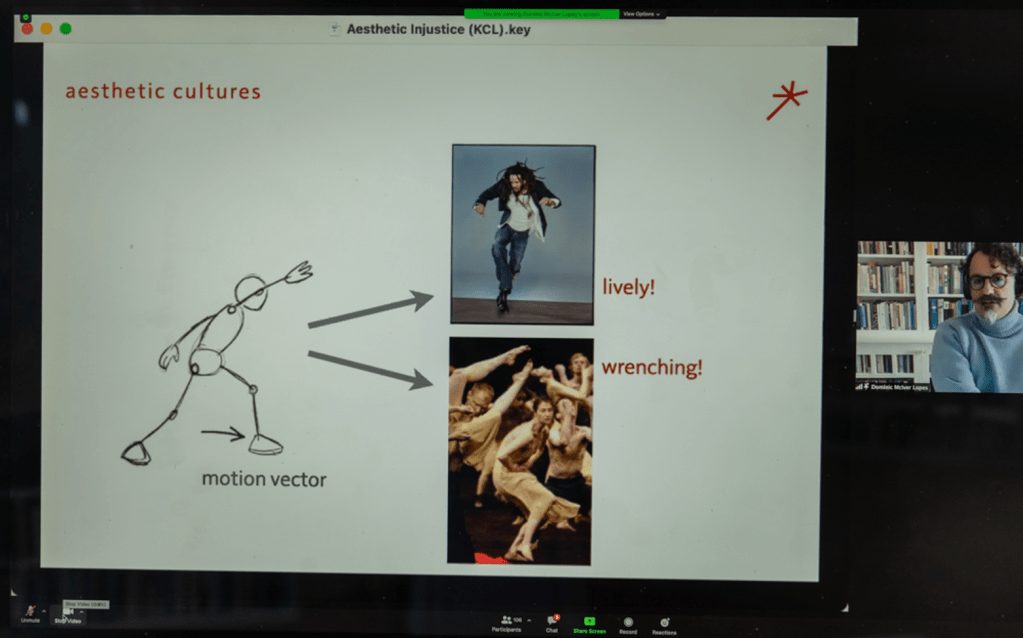
According to Lopes, justice is goodness in a relatively large-scale social arrangement. Injustice is thereby badness in such a social arrangement. Aesthetic injustice becomes an issue when cultures encounter one another. The motivating example of the talk was the Canadian government’s use of Haida aesthetic culture (the Spirit of Haida Gwaii sculpture) on the $20 bill. There seemed to be something not quite right about the use of this First Nation art on the national currency. Lopes’s explanation for this is that the use of aesthetic culture subverted the process through which the Haida people fix their own aesthetic profile, contrary to the interest in social autonomy.
The account of aesthetic injustice maps on quite nicely to the familiar notion of political injustice. This is because there is an appeal to the large-scale structural features of society that frame how individuals come into contact with one another. This mirrors the typical approach in political philosophy of seeing justice as a matter of the fundamental political and economic institutions of society.
I will note two points. First, Lopes’s view assumes a perfectionist orientated approach to justice. Perfectionists appeal to an account of a good human life in their accounts of justice. (But what exactly is a good human life?) It is a great contribution, however, to conceive of aesthetic interests as being relevant to justice. The perfectionist approach can be contrasted with approaches of justice such as “realism” which aim to secure conditions for the non-violent coexistence of cultural communities.
Second, Lopes argues that aesthetic injustice can undermine individuals’ capacities to realise the interests of the value of diverse schemes of aesthetic value as well as communities’ interest in social autonomy. These interests can be viewed as part of an account of a good human life, where the former states that it is good, for instance, that there are different ways of doing rock music, and the latter refers to the good of being able to shape one’s life and have an impact on surrounding social practices. Lopes suggested that justice with respect to these interests can be seen as an aspiration to the maximum, and injustice can be seen as the falling below some threshold, where individuals’ capacities to realise these interests are set back to a sufficient degree. But where, we may ask, is this threshold? And what are the particularly aesthetic interests (if any) that are set back by aesthetic injustice? I look forward to hearing more about Lopes’s excellent work on this fascinating area.
by Mathilde Victoria Prietzel Nielsen, 1st year Undergraduate in Philosophy
A network theory of art and artistic value
On March 16th the annual Sainsbury lecture was held as it is tradition to honour Richard Mark Sainsbury’s contributions to King’s Philosophy department. This year’s King’s had the honour of hosting distinguished University Scholar and Professor in the Department of Philosophy at the University of British Columbia, Dominic Lopes and the topic ‘Aesthetic Injustice’. An overlooked phenomenon in philosophy, that is, before the night’s lecture in which Dominic took the audience through his forthcoming ‘cosmopolitan theory of aesthetic injustice’. The theory aims at tracking down and bringing to light any aesthetic injustice where other theories fail to do so. To test the validity of the theory, Lopes presented and evaluated cases of aesthetic justice and injustice, first single-handed and later in joint research with the audience members, thus subtly but clearly demonstrating one of the theory’s main claims, that the success of an aesthetic culture’s profile – it could be that of philosophy – stands and falls not with the success of the individual philosopher (or dancer, or barista, or mathematician) but with the success of the (philosophical, dancing, coffee-making, calculating) community. Indeed, if the single aesthetic agents (philosophers, dancers, baristas, mathematicians) fail to work together towards the jointly agreed to aesthetic value, the aesthetic culture fails entirely. In each case – from rap to tap dance to computer games – Lopes kept a strict eye on the nuances and intricacies, thus constantly bringing the audience’s attention to another perhaps more general, yet easily neglected point: nuances matter. Concluding that the cosmopolitan theory is indeed successful in bringing to light otherwise sombre aesthetic injustices, questions were attended to, well-considered and answered, and noted down for final editorial remarks.
Join us for the AnnualPeace Lecture – online link to follow.
Tuesday 11 May 2021, 17:00-19:00
Cécile Fabre:
Snatching Something From Death:
Value, Justice, and Humankind’s Common Heritage
When Notre-Dame Cathedral was engulfed by fire on April 15, 2019, the world (it seemed) watched in horror. On Twitter, Facebook, in newspapers and on TV cables ranging as far afield from Paris as South Africa, China and Chile, people expressed their sorrow at the partial destruction of the church, and retrospective anguish at the thought of what might very well have happened – the complete loss of a jewel of Gothic architecture whose value somehow transcends time and space. My aim in this lecture is to offer a philosophical account and defence of the view that there is such a thing as humankind’s common heritage, and that this heritage makes stringent moral demands on us. I first offer an account of the universal value of (some) heritage goods, and then offer a conception of justice at the bar of which we owe it to one another, but also to our ancestors and successors, to preserve that heritage.
Professor Cécile Fabre is a Fellow of the British Academy, Senior Research Fellow at All Souls College, and Professor of Political Philosophy at Oxford University.
The lecture will be chaired by Professor MM McCabe, FBA, Chair of the British Academy Philosophy Section and Professor of Ancient Philosophy Emerita, King’s College London.
The Peace Lectures are due to Alan Lacey, a life-long pacifist who taught philosophy at King’s College London for some fifteen years, and who left a generous bequest to fund a lecture series promoting peace.
Topic: Simon Critchely ‘Pandemic Mysticism’Time: Apr 8, 2021 07:00 PM London to join the Zoom Meeting please email your details to mathilde.prietzel_nielsen@kcl.ac.uk
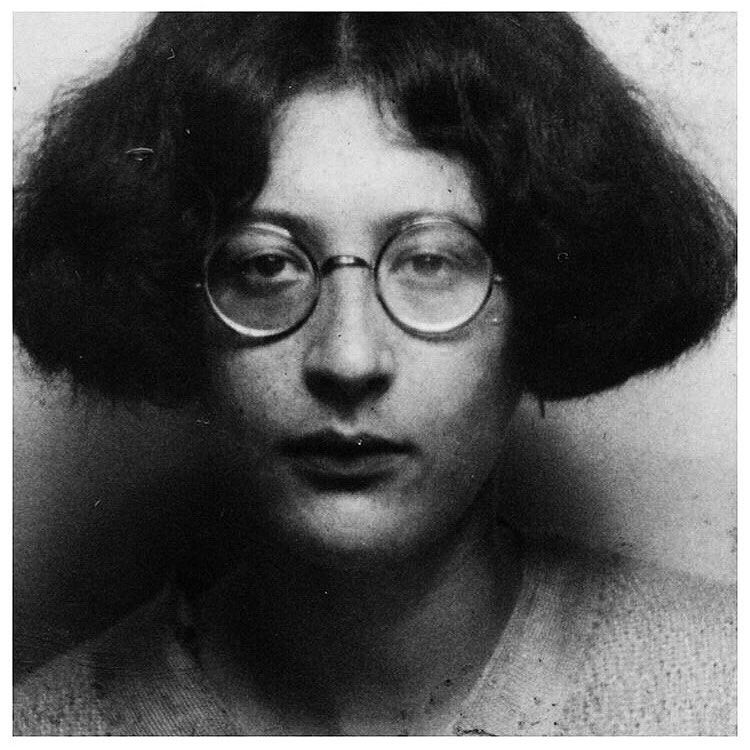
Simone Weil
Seminar outline.
In the wake of COVID-19, many of us have grown used to being hermits, socially distanced and masked against a contaminated and untrustworthy reality defined by pestilence, suffering and death. In a world of contagion – possibly being contagious ourselves – we have followed a practice that the ancients called anachoreisis, a withdrawal into solitude, a retreat from the world. Whether we liked it or not, we all became anchorites or anchoresses. There is a strange asceticism to the world of lockdown and disease which opened us up to extreme experiences of doubt, dereliction, dreams, hypochondria, hallucination, and a desperate desire for love or a connection with something or someone outside or larger than the self. These experiences and emotion have profound historical and religious echoes with the logic, poetics and practices of mysticism. It is as if something elemental and primeval has been revived in the pandemic. Perhaps it is worth looking into. It seems to me, then, that this might be an opportune moment to study some mystical texts together and think about the nature of mystical experience. Such is the simple purpose of this seminar. In its attempts to articulate religious experience in thought, mysticism both borrows heavily from philosophy and undermines its standard procedures. What often results is a strange philosophy of contradictions, confessions, and enigmas. While not being blind to the many mystical traditions, we will focus on Christian mysticism, especially medieval texts, and especially those written by women. Authors that may be included are: Dionysius the Areopagite, Hadewych of Antwerp, Meister Eckhart, Marguerite Porete, Julian of Norwich, Margery Kempe, Angela of Foligno, and others. The seminar will also include selections from more recent authors inspired this tradition, for example William James, Bataille, Lacan, Michel de Certeau, Simone Weil, R.D. Laing, Caroline Bynum and Amy Hollywood. We will pay attention to the political dimension of these traditions that are focused around the odd phenomenon of mystical anarchism. And we will also pay attention to the relation of mystical experience to popular music in various forms.
This seminar has been organised by Mathilde Prietzel Nielsen, 1st year Philosophy student. Please email mathilde.prietzel_nielsen@kcl.ac.uk for the zoom conference login details.










 King's Philosophy