Colette Olive, PhD Candidate and Administrator for the centre for Philosophy and Art . (And occasional ‘ClapperBoarder’.)
Making the Films at The National Gallery
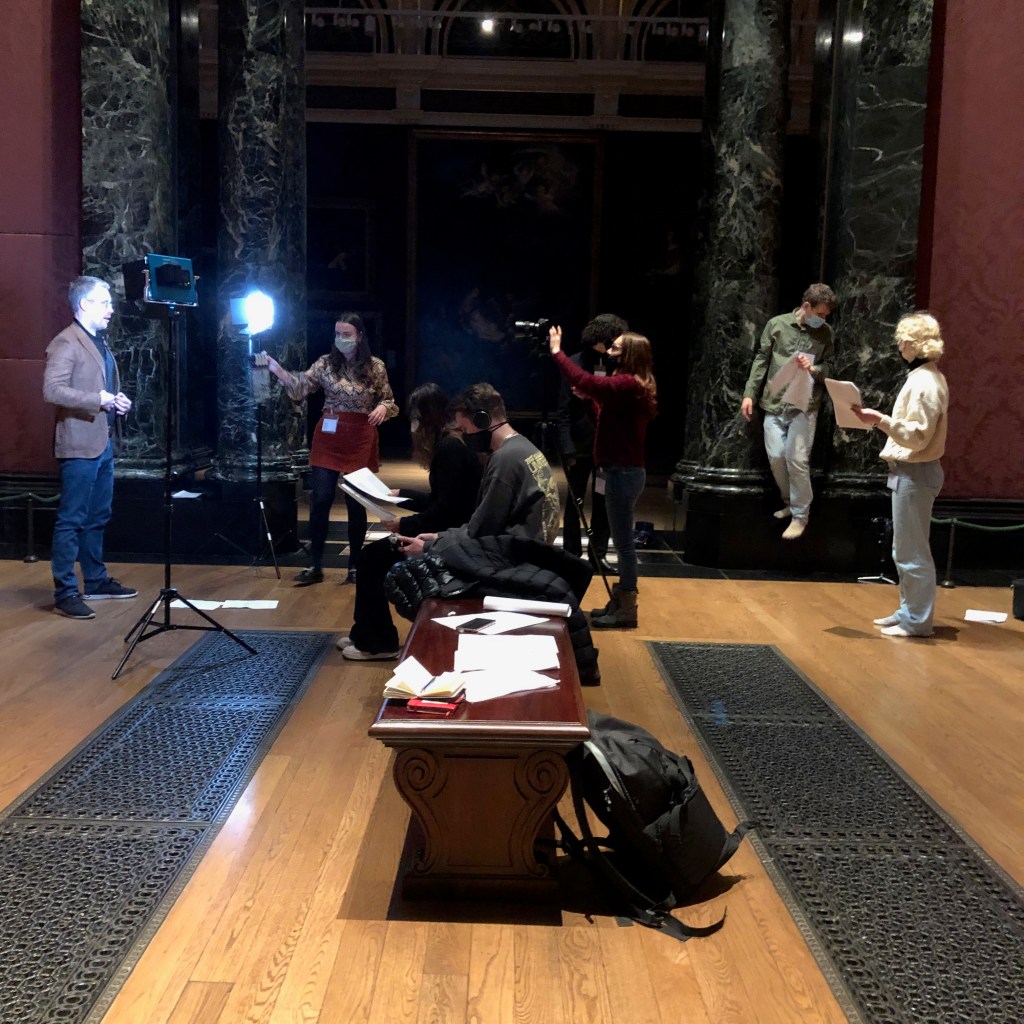
Getting to visit the National Gallery after hours felt like a once in a lifetime opportunity. I felt like I was having a more personal encounter with the paintings. As a member of staff accompanying us put it, the paintings felt more present. The motion sensor lights would periodically go off and we needed to do a lot of dancing to keep them on! The inconsistent lighting made the paintings feel more dynamic. Watching Vanessa and Sacha bring out elements in the paintings I’ve never noticed before gave me a new perspective on the works. join us at our upcoming event ‘The Pleasures of Regret‘ learn more about these paintings too!
Mathilde Victoria Prietzel Nielsen (she/her)President of King’s College London Philosophy Society Undergraduate at King’s College London Department of Philosophy
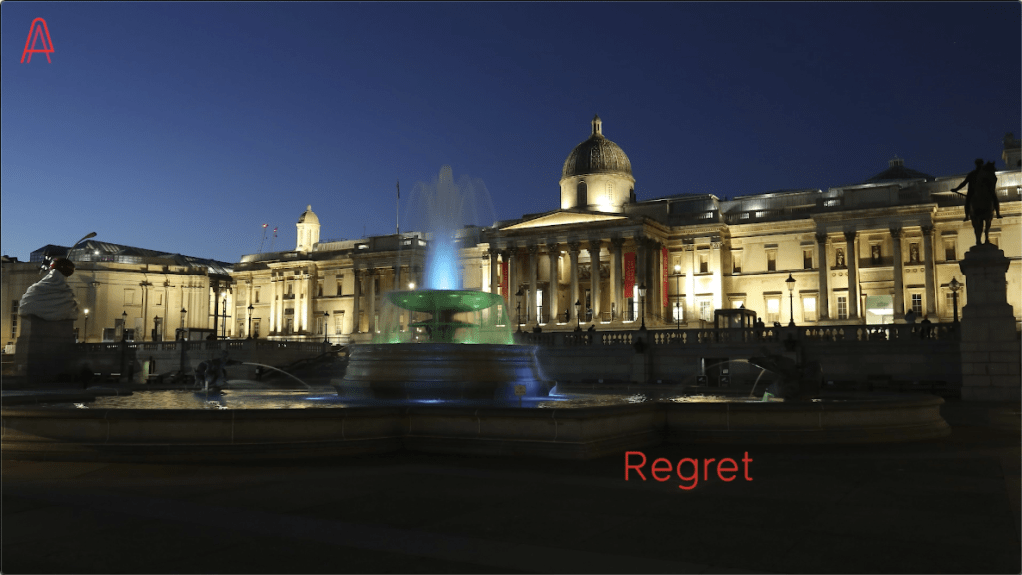
Mathilde stars with the crew in the adspot for ‘The Pleasures of Regret’
We were summoned at the Prêt across the National Gallery to meet each other, get fuel, a run-through of the plan, and role assignments. I was to be the checker, that is, to keep track of which shots we had done and which we hadn’t (this was not done sequentially!). Other roles included clapper (the wooden board, not hands), extra set of ears, extra set of eyes, prompter/stylist, equipment gather-carrier-set-upper. Once the roles had been assigned we went to the gallery to be let into the gloriously silent halls to get our badges (so as to not get hand-cuffed for wandering the halls at night) before going through the galleries to our first shot, and I must say: Monet, Picasso, and the rest of the gang makes a whole other experience when not diffused by the usual museum buzz.
Though not required, you intuitively lower your eyes, widen your gaze, and raise eyebrows to communicate to and agree with the others that this is not the usual museum experience – it is of course far better.
That is, it is better when you are together with your crew or for the first 150 meters walking alone.
Around 160 you start wondering whether you’re lost and, if so, whom to call on. Cézanne? Raphael? As a team, our main job turned out to be how to keep the lights on whilst keeping the sound off: light sensors required us to keep walking about when filming in order to keep the light on, but it happens that wooden floors may squeak, so we caught ourselves in quite the dilemma (a suitable environment for philosophers, sure). The dilemma we solved with a fusion of modern dance and loss of shoes. The night we rounded off with a communal, laugh, stretch, and yawn.
The centre for Philosophy and Arts (KCL) are delighted to announce a new series of events exploring the relationship between art and our emotions. The series launches at The National Gallery with a film, panel discussion, and Q&A on regret. Reserve your free zoom seat here and join Vanessa Brassey from King’s College London, Andy West, author of ‘The Life Inside: A Memoir of Prison, Family and Philosophy’, and author and arts journalist Chloë Ashby. The event will be chaired by Sacha Golob, King’s College London.
So, what will we be discussing?
Regrets may be painful or bittersweet. They can be ethically loaded or merely a plaintive ‘perhaps’. Perhaps you could’ve been a contender; loved more kindly; been more philanthropic; or sold your bitcoin before December?
This means that regret is an aromatic concoction of nostalgia, reminiscing and grief with gentle top notes of longing. We will be thinking about the ways it can also be intensely and weirdly pleasurable. And how pictures help us to understand this, on their own special way.
The Art & Emotion series. Free (but pre-registration required). Make sure you get your seat.
In collaboration with and hosted by The National Gallery London.
The Peace Lectures are due to Alan Lacey, a life-long pacifist who taught philosophy at King’s College London for some fifteen years, and who left a generous bequest to fund a lecture series promoting peace. The series is organized by KCL Philosophy Department.
The lecture will be followed by a reception at Bush House, 8th Floor (South) and by the announcement of the winners of the Estella Newsome Memorial Prize essay competition (sponsored by the Christian Campaign for Nuclear Disarmament).
The film’s twin love stories contrast two ways of understanding what tethers us to someone: personal qualities and shared history – Noël Carroll. (LANDMARK MEDIA / Alamy)
@aj_wendland launched and runs the philosophy column in TheNew Statesman called Agora, which is a space for academics to address contemporary social, political and cultural issues from a philosophical point of view.
by Jo Wolff (@JoWolffBSG), the Alfred Landecker professor of values and public policy at the Blavatnik School of Government, and governing body fellow at Wolfson College, Oxford!
Democracy is a battle of ideas, but one that depends on treating opponents as legitimate adversaries not treasonous enemies. – Jo Wolff (Oxford)
@aj_wendland launched and runs the philosophy column in TheNew Statesman called Agora, which is a space for academics to address contemporary social, political and cultural issues from a philosophical point of view.
Wishing everyone a safe and restful holiday season! – King’s Department of Philosophy (@kingsphilosophy)
Statistics can illuminate the world, but narratives explain why the numbers matter – Alex Prescott-Couch (Oxford).
See this new article by @prescottcouch on storytelling in the social sciences in @aj_wendland‘s Agora series @NewStatesman. @aj_wendland launched and runs the philosophy column in TheNew Statesman called Agora, which is a space for academics to address contemporary social, political and cultural issues from a philosophical point of view.
In a new 15 minute Masterclass Youtube video, Professor Bill Brewer (@mbillbrewer), Susan Stebbing Professor of Philosophy at King’s College London, asks whether we perceive the physical world directly: https://www.youtube.com/watch?v=oRmDqOOYs2k
‘Why are there beings at all instead of nothing? That is the question,’ said philosopher Martin Heidegger.
In 1929, German philosopher Martin Heidegger gave a lecture at the University of Freiburg. He spoke at length — poetically and densely — about nothing. Many were enthralled by his talk, but scientist-philosopher Rudolf Carnap thought his talk of nothing, added up to… nothing. (Shutterstock / Jared Romanowicz)
Charles Mills, who died earlier this year, was a model for a political philosophy engaged with subjects the discipline had systematically ignored, first among them race and racism.
You can also read Sophie’s (@DrSophieSmith) most recent article, “Historicising Rawls”, which elaborates on Charles Mills’s contributions to the history of 20th-century political philosophy.






 King's Philosophy