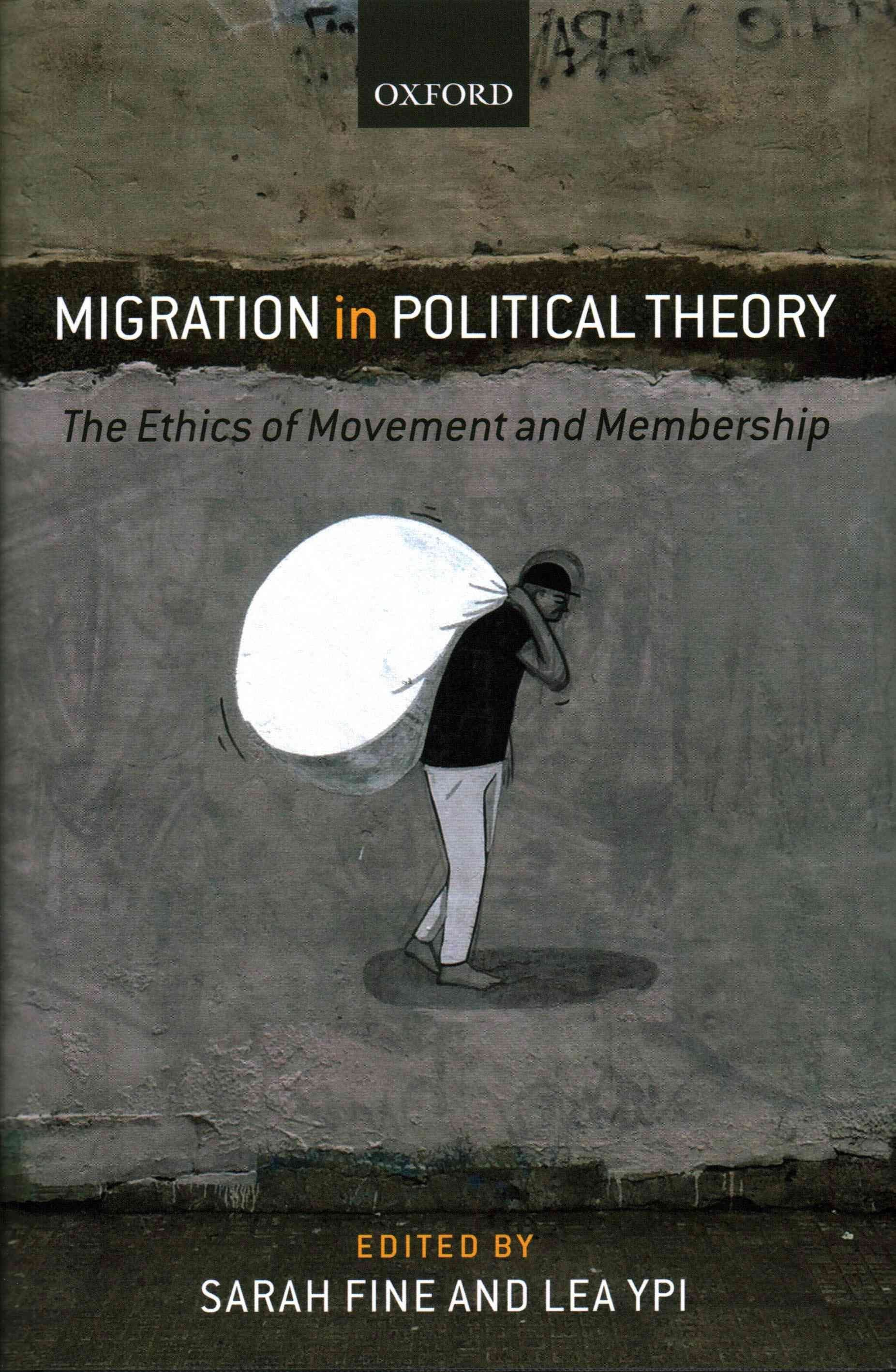
The collection Migration in Political Theory: The Ethics of Movement and Membership edited by Dr Sarah Fine and Prof Lea Ypi has been announced as one of the most visited works within political science on Oxford Scholarship Online.
The volume which also includes Dr Fine’s paper Immigration and Discrimination was first published in 2016.
To see which other works have been most visited, click here.
The UK Kant Society, of which our own Dr Jessica Leech is the Secretary, has a new website – ukks.co.uk.
The society exists to encourage study of all aspects of the philosophy of Immanuel Kant, including relations to his historical predecessors, successors, as well as Kantian influence in contemporary philosophy.
While their annual conference has been cancelled this year, check ukks.co.uk/events for details of the Inaugural Online Lecture, to be delivered by Prof Patrick Frierson.
Sarah Fine will be giving this year’s Lumsden lecture at the University of Nottingham. This is an annual event organised by the University of Nottingham’s PhilSoc involving a public lecture by a visiting academic.
Sarah works on political philosophy, in particular on issues of migration, citizenship, nationalism, race, and feminism.
Her talk – “Knowing My Place” – will take place at 2pm on 9th July. Sign up for the eventbrite and you will be sent a Jitsi link and password to attend the event.
The Philosophy Department at King’s College London is seeking an outstanding philosopher with research expertise and teaching experience in philosophy of mind and philosophy of psychology. Competence and ability to teach at all levels in philosophy of mind and philosophy of psychology are required. The successful candidate will be involved in teaching philosophy modules in Neuroscience and the Mind and Advanced Topics in the Philosophy of Mind to students following the BSc in Neuroscience and other undergraduate courses in the Health Schools. Research specialization in philosophy of mind and/or philosophy of psychology is also required.
This is a permanent post to begin on 1 September 2020.
The Department of Philosophy at King’s College London is seeking to appoint a Lecturer in Philosophy to cover for staff on Leverhulme funded research leave. The successful candidate will be asked to teach BA and MA modules in moral and/or political philosophy and may be asked to teach some epistemology; to supervise undergraduate, MA and Postgraduate research students in moral and/or political philosophy; to carry out world-class research; to perform assigned administrative duties; and to assist with the pastoral support of students. The Lecturer will be supported through mentoring and training to develop their career.
This post will be offered on a fixed-term contract to begin on 1 September 2020 and end on 31st August 2021.
Prof Maria Rosa Antognazza will be presenting a paper this evening at the Aristotelian Society on The Distinction of Kind between Knowledge and Belief. The presentation, which will be hosted on Zoom, will be available later as a podcast. Both a draft of the paper and a link to the podcast are available here.
The Distinction of Kind between Knowledge and Belief.
Abstract:
Drawing inspiration from a well-attested historical tradition, I propose an account of cognition according to which knowledge is not only conceptually and ontologically prior to belief; it is also, and crucially, not a kind of belief. In turn, believing is not some sort of botched knowing but a mental state fundamentally different from knowing, with its own distinctive and complementary role in our cognitive life. I conclude that the main battle-line in the history of epistemology is drawn between the affirmation of a natural mental state in which there is a contact between ‘mind’ and ‘reality’ (whatever the ontological nature of this ‘reality’), and the rejection of such a natural mental state. For the former position, there is a mental state which is different in kind from belief, and which is constituted by the presence of the object of cognition to the cognitive subject, with no gap between them. For the latter position, all our cognition is belief, and the question becomes how and when belief is permissible.
James Read will give the BBLOC (Birmingham-Bristol-London-Oxford-Cambridge) Philosophy of Physics research seminar this term on ‘Newtonian Equivalence Principles’.
Epidemiological models have been frequently mentioned in the media lately. What are they? And how do they work? Professor Alexander Bird with the Sowerby/King’s Philosophy & Medicine project has helpfully produced this introduction to epidemiological modelling for the layperson.
The particular model he will be looking at is the SIR model developed by Kermack and McKendrick in 1927.
Here’s a link to the project. Professor Bird has also produced a paper to accompany the video which is available here.
As everyone is locked up, Clayton Littlejohn has been helpfully recording and gather talks on some recent work in philosophy. This talk is an informal presentation of a paper written with Julien Dutant on epistemic rationality and defeat. It presents a new unified theory of defeat according to which the toxicity of rationality defeaters has to do with the way in which they serve as indicators that we cannot know certain things. The paper engages with recent work on epistemic paradoxes, epistemic rationality, and recent work on defeat.
If you are interested, there are more videos available here.




 King's Philosophy