Joe McKenzie is running a Wittgenstein Reading Group (Wednesdays at 3pm, Room 605, Philosophy Building). If anyone wants to come they should email joseph.mckenzie@kcl.ac.uk
There are currently several reading groups running in the department. Even if you haven’t attended any before, you are more than welcome to drop by. MA students are particularly welcome.
(Mostly) Metaphysics Reading Group: Wednesday 1pm, Room 508, Philosophy Building
This term: Individuals by P.F. Strawson
Email: roope-kristian.ryymin@kcl.ac.uk
Philosophy of Mind: Wednesday, 11am, Room 508, Philosophy Building
(alternates with A Spirit of Trust)
Email: patrick.butlin@kcl.ac.uk
A Spirit of Trust: Wednesday, 11am, Room 508, Philosophy Building
(alternates with Philosophy of Mind)
Email: fintan.mallory@kcl.ac.uk
Phenomenology in Analytic Philosophy: Wednesday 3pm, Room 508, Philosophy Building
Activity Room E, 8th Floor South East Wing, Bush House
In the paper, Dotson considers how a culture of justification in academic philosophy is creating a difficult working environment for academic philosophers from diverse backgrounds and what can be done to change this! As the paper is a bit on the longer side, we will be focusing on sections 2-5, but you are more than welcome to read the whole thing if you have the time and energy!
The reading is open to all! Please feel free to come along and join.
Continuing our series of interviews with new members of staff, we have Dr. Katharine O’Reilly.
Katharine (and Roscoe)
Where were you before coming to Kings?
Immediately before coming to King’s I wrote my D.Phil at University College Oxford, but there’s also a sense in which I have been at King’s for nearly a decade. I took the M.Phil Stud. in Ancient Philosophy here from 2010-2014, I have been a GTA from then until now, and in 2018-19, the year I was finishing my D.Phil, I held the Analysis Trust Studentship here in the Department. I’ve also worked on two projects in the Department for a number of years: the Ancient Commentators on Aristotle Project, and the British Journal for the History of Philosophy. As you can probably tell, I’m a very big fan of King’s Philosophy (and now Classics! I’m cross-appointed there).
What got you into philosophy?
When I started University in Canada (University of Toronto) I didn’t really know what philosophy was. But having been at French Immersion schools up until then, it turns out I had been exposed to good deal of philosophy, by way of authors such as Camus and Voltaire. I thought I would be an English major, but in North America you don’t have to declare right away, and can take a breadth of courses in the first year. I signed up to Mark Kingwell’s Introduction to Philosophy because the reading list looked so great. I was immediately hooked.
One focus of your research is prudentialism in the ancient world. Could you tell us what attracted you to this?
My research is broadly interested in ancient moral psychology, and within that realm, I’m particularly interested in prudentialism in the sense of the strategies ancient thinkers and schools recommend for conceiving of and concerning oneself with ones own good. I became interested in this topic by observing the diversity of approaches to thinking about ourselves and our lives in ancient texts. Some suggest we think about our future selves and their good, some our lives as a whole, some our posthumous good, some the recollected goods of our past. I became very interested in the way this kind of autobiographical and prudential thinking underlies the strategies and therapies different figures recommend their followers adopt in order to bring about the right kind of self-interest. So far I have been considering these issue within the thought of Plato, Aristotle, and the Hellenistic schools.
You’ve argued that Plato isn’t as strictly opposed to hedonism as he is sometimes made out to be. What have we been getting wrong about him?
Plato is often characterised as decidedly anti-hedonist. He presents Socrates in dialogue with hedonists repeatedly, and that is usually to critique them, and show that the life they thought they could pursue, with pleasure as its goal, isn’t one they can or should pursue successfully. What this reading misses out, I think, is Plato’s deep and sustained interest in pleasure and the role it ought to play in our lives. He is anything but dismissive of hedonist arguments: he takes them seriously again and again, and even devotes an entire late dialogue (the Philebus) to thinking about the nature of pleasure. That doesn’t mean that Plato is a fan of hedonism, or isn’t critical of it, but what I think it does mean is that he is interested enough in the arguments to develop multiple analyses of the psychology of pleasure and pain. If we read Plato as too dismissive of hedonism, we risk missing the insights these discussions provide. So I would rather characterise Plato as being fascinated by pleasure.
Is there a philosophical idea that you endorse that most people don’t but should?
I think the Cyrenaic advice about anticipating future pain is far more effective than most people give it credit for.
Wouldn’t it be better to be a jellyfish?
Not according to Plato (or so I argue here)! But as the deadlines stack up, it is tempting…
After finishing my PhD at UC Berkeley, I spent a few years at UCL as a teaching fellow, and some time at Umeå University in Sweden—which by the way is a great place to do philosophy—as a research fellow.
What got you into philosophy?
When I first started as an undergraduate, I thought I’d do a degree in biology. I took a logic course in my first year, though, and that changed everything.
You’ve written about the philosophical implications of language death. What is lost when we lose a language?
There are too many things to list! In the stuff I’ve written on this question, I’ve tried to call attention to some that I think are both particularly important and a bit hard to see. For example, while philosophers mostly reject the idea that there are things you can say in one language that you can’t say in any other, I think there is space open for us to think that there are things you can do in one language that you can’t do in any other. This means that when a language is lost, so is a class of possible actions. Since I think the space of possible things we can do amounts, in a fairly direct way, to the space of people we can be, this is a problematic loss.
Why do you think philosophers have traditionally overlooked this issue?
To be honest, I have often wondered this myself. I imagine it has something to do with the fact that you can more-or-less get by these days speaking only English, and probably something to do with the fact that philosophers tend to think of languages as more-or-less interchangeable signaling systems.
Is there a philosophical idea that you endorse that most people don’t but should?
I’d have to say metasemantic pluralism.
You can find out more about Ethan’s work on his website
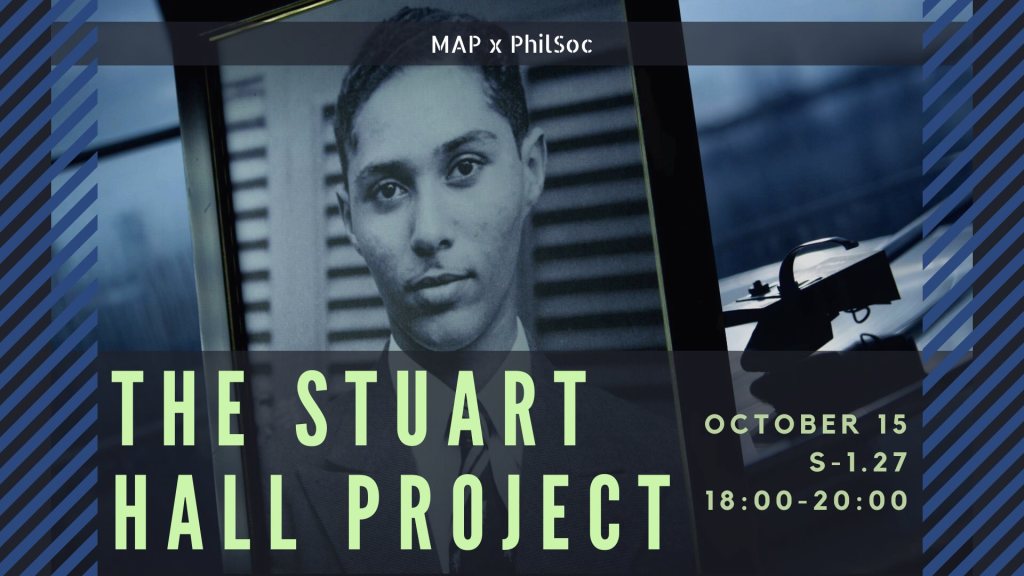
In celebration of Black History Month, MAP and PhilSoc will be co-hosting a film screening of the documentary ‘The Stuart Hall Project’ (2013), written and directed by Black British artist and writer John Akomfrah.
Tuesday 15th October, 18:00-20:00
Strand Campus, S -1.27 (wheelchair accessible)
Stuart Hall was a Jamaican-born British philosopher, critical theorist, sociologist, and Marxist. He is considered one of the founding figures of the ‘New Left’ political movement of the 60s and 70s, as we as central to the development of Cultural Studies in Britain. The documentary looks at Hall’s life from colonial Jamaica to British intellectual, exploring themes of identity, diaspora, post-coloniality, and what it meant to be Black and British during the 70s.
Raymond Tallis: Are you your Brain? Neuroscience and Neuromania
Professor Raymond Tallis FMedSci FRCP FRSA
Theatre 2, New Hunt’s House, KCL Guy’s Campus
The lecture will be introduced by Lord Turnberg FRCP FMedSci, past president of the Royal College of Physicians.
Professor Tallis is the author of Why the Mind is Not a Computer: A Pocket Dictionary on Neuromythology, The Kingdom of Infinite Space: A Fantastical Journey Around Your Head, and most recently Logos: The Mystery of How We Make Sense of the World.
For more information on the speaker and the lectures: click here
REGISTRATION: Registration is required so that King’s Estate Security have the names of all external visitors. You should not register if you have a valid King’s ID. You must register with your full name and email if you are a visitor – you can omit all other information. For further questions, email philosophyandmedicine@gmail.com.
A new series of the Phenomenology Reading group starts next Wednesday, 9thOctober: 15:00-16:00 in the Emeritus Room (PB508). The group will cover papers that connect the detailed descriptions of phenomenology with systematic debates from analytic philosophy. Anyone is welcome!
For the first week, we will discuss Hubert Dreyfus’ seminal 2005 paper Overcoming the Myth of the Mental: How Philosophers can Profit from the Phenomenology of Everyday Expertise. (download from JSTOR here). For those short on time but still wanting to join, there is a 6-page version from 2006 published in Topoi.
For a list of suggested readings, or if the time and date are not suitable for you, as well as any other questions, do not hesitate to contact Gregor Bös.
KCL MAP reading group will be meeting 13:00 – 14:00 next Wednesday, 9th October, in Activity room E, KCLSU (Bush House, South East Wing). The reading is ‘Reparations and Racial Inequality’, by Derrick Darby, University of Kansas (see file/abstract below). The reading group is open to all — staff, students, PGTs and PGRs, within and external to the department. All are welcome to attend!
Abstract: A recent development in philosophical scholarship on reparations for black chattel slavery and Jim Crow segregation is reliance upon social science in normative arguments for reparations. Although there are certainly positive things to be said in favor of an empirically informed normative argument for black reparations, given the depth of empirical disagreement about the causes of persistent racial inequalities, and the ethos of ‘post-racial’ America, the strongest normative argument for reparations may be one that goes through irrespective of how we ultimately explain the causes of racial inequalities. By illuminating the interplay between normative political philosophy and social scientific explanations of racial inequality in the prevailing corrective justice argument for black reparations, I shall explain why an alternative normative argument, which is not tethered to a particular empirical explanation of racial inequality, may be more appealing.
Prof. Sarah Fine will be chairing a panel discussion on the ethics of exhibiting to be held at the Photographer’s Gallery on Wednesday 25th September. This is part of an ongoing collaboration between The Photographers’ Gallery and the Centre for Philosophy and the Visual Arts at King’s College London.
Speakers include the playwright and researcher, Raminder Kaur (University of Sussex); anthropologist and art historian Christopher Pinney (University College London); curator and cultural historian Mark Sealy (Autograph ABP).





 King's Philosophy